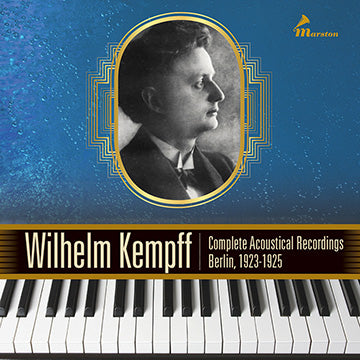
Wilhelm Kempff
Friedrich Wilhelm Walter Kempff (1895–1991) is considered one of the great pianists of the twentieth century. One of the last chief exponents of the Germanic piano tradition, Kempff is particularly well known for his interpretations of Beethoven and Schubert. He is often best remembered for his warmth and poetic insights, sensitivity, and beautiful phrasing, yet this set of Kempff’s earliest recordings also reveal a young firebrand: a technical marvel capable of stunning, extroverted virtuosity.Wilhelm Kempff was awarded two scholarships to the Berlin Hochschule für Musik at the age of nine: one to study piano with Heinrich Barth, and another to study composition with Brahms’s close friend and disciple Robert Kahn, both of whom had previously taught Artur Rubinstein. In 1917, Kempff gave his first major recital, consisting of predominantly major works, including Beethoven’s “Hammerklavier” and Brahms’s “Variations on a Theme of Paganini”. Kempff toured extensively during his career yet